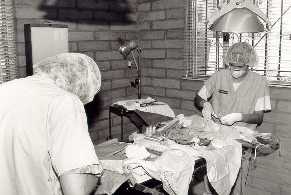
FERAL CAT OVERPOPULATION IS A COMMUNITY-GENERATED PROBLEM,
THE COMMUNITY HAS THE RESPONSIBILITY TO WORK TOWARD A SOLUTION.
 |
 |
The 2 videos embedded in the pictures above explains why Trap/ Euthanize doesn't work to reduce cats over the long term and is hugely expensive to tax payers--- TNR is free and reduces feral cat populations humanely.
A simple procedure known as ‘ear tipping’ is becoming the universal sign
that a cat is ‘fixed’. While there are a few clinics that clip the tip
of the right ear, or make a notch, the vast majority of facilities
working with cats clip the tip of the left ear while the cat is already
asleep for its spay or neuter.
What is TNR (Trap-Neuter-Return)?
TNR is the humane way to reduce feral cat overpopulation
and has been utilized in Europe, the UK, parts of Asia and
the US since the 1970's.
The following is excerpted from the Humane Society of
the United States material. At the base of this page
are links to additional excellent TNR resources.
The TNR approach involves trapping the all cats in a feral colony, having them neutered, marked for identification and vaccinated for rabies, and returning the truely feral (cats unadapted to humans) to their original territory.
A caretaker then provides regular food and shelter and monitors the colony over time for newcomers and any potential problems that may arise. Ideally, all the cats in the colony will be caught and fixed and every effort should be made to do so, even if they can’t all be trapped at once. Caretaking a feral colony is made much easier when the neutering rate is 100 percent. Otherwise, that one female you didn’t get may keep having litters of kittens. Still, getting most of the adults fixed will at least temporarily stabilize and improve the situation.
Features of TNR
Rehoming Kittens and Friendly Cats
Whenever possible, kittens young enough to be easily socialized are removed from the colony along with friendly adults who are clearly former domestics and can be re-homed. Removing adoptable cats immediately reduces the size of the feral population (a primary goal of TNR) and gives the removed cats a chance at longer, safer lives. That said, if foster resources are not available, the TNR of the colony should not be delayed.
Neutered Cats are marked for future ID by Eartipping (see photos at right)
The minimum veterinary intervention upon capture includes spay/neuter, “eartipping” and rabies vaccinations. Eartipping is a procedure where a 1/4 inch off the tip of the left ear is removed in a straight line cut. It is the only reliable method known for identifying a neutered feral and is used globally.
Returning
Following surgery and a recovery period lasting usually two to three days, the ferals are returned to their territory. They must be brought back to the location where they were trapped and not released elsewhere – ferals are extremely tied to their surroundings and will flee in search of familiar surroundings if placed somewhere new without a proper relocation effort having been made.
Caretaking
The cats will continuously need food and shelter and should be provided these basic necessities in as consistent a manner as possible. Moreover, many things will happen over the years of the cats’ lives, such as new unaltered cats occasionally showing up, injuries or other health issues, conflicts with neighborhood residents and the like. When a caretaker is present to address these matters, the cats are more likely to lead a healthier and safer life than if they are left on their own.
A caretaker who watches for new cats will also help sustain the gradual reduction in the colony’s size over time through attrition.
Advantages of TNR
Colony Level Trap-Neuter-Return has many benefits when all or almost all of the cats in a colony are neutered:
- Population stabilization - The size of the colony stabilizes as new litters are either eliminated or greatly reduced in number. Gradually, if newborns or newly arrived friendly strays are promptly removed from the colony as they appear, the number of cats will decline over time.
- Noise reduction - A common complaint about feral cats is their high-pitched screeching in the middle of the night, which can disturb the sleep of an entire residential block. Most of this noise is the result of mating or fighting – behaviors which are eliminated or greatly lessened after neutering. Not that you won’t hear a good snarl once in a while, but not to the point where it becomes a constant nuisance.
- Foul odors reduced - The noxious odor often associated with the presence of feral cats in an area is caused primarily by unaltered males spraying to mark their territory. Testosterone mixed in the urine is responsible for the powerful smell. Neutering stops the cat’s production of testosterone and, a few weeks after the surgery, any remaining testosterone has cycled out of the cat’s system and the odor is eliminated. In my experience, most male cats stop spraying completely after they’re altered, but even if they don’t, the “I can’t even use my own backyard” smell is gone.
- Less visibility – Once mating behavior is eliminated, the cats tend to roam much less and stick closer to home base where food and shelter is supplied. As a result, they become a less visible presence in the area and are less likely to sustain fatal accidents with cars.
- New cats are kept out – Feral cats tend to resist the intrusion of new cats into their territory. The degree to which they keep out newcomers is a function of the size of their food supply and territory. If they have a small territory and are fed only as much as they need, colony cats are highly motivated to guard their small space and limited food supply from newcomers. On the other extreme, if only a few cats inhabit a large space and are provided unlimited food, they may be more willing to allow new cats to join them.
- Rodent control – Cats deter rodents, more by their scent than by hunting. Feral cats’ best friends are often the superintendents of buildings or managers of warehouses because these people know the choice is cats or rats and prefer the former. Typically, someone will bring a cat or two into a rodent-infested situation in to alleviate the problem. However, new problems arise when the cats proliferate. With TNR, the cats get to stay, the nuisance problems from feline overpopulation are eliminated and rodent control is maintained.
- Improved community relations - When a feral cat colony is out of control, with litters of kittens continually recurring and noise and odor a real complaint, neighborhood residents often become hostile towards both the cats and anyone they believe is helping perpetuate the situation, such as feeders. When TNR is implemented and its advantages realized, the caretaker becomes an asset to the community instead of an enemy and the cats are better tolerated.
Links To Even More TNR Details
Humane Society of the United States: Feral Cats
Alley Cat Allies: Conduct Trap-Neuter-Return
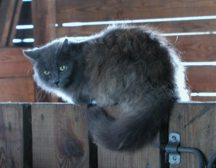 Click Photo for Resources & Link | CATLANTA (hosted by Atlantapets.org) is a resource for people wanting to implement TNR programs in their neighborhoods, businesses, or other areas of interest. The cats are trapped, spayed or neutered, vaccinated, and released back to their neighborhood. CATLANTA provides traps and trapping instructions and utilizes the LifeLine Spay & Neuter Clinic to spay or neuter ferals. |
Atlanta Area
Low-cost Spay Feral Cat Spay - Neuter Clinics
- LifeLine Spay & Neuter Clinic • www.AtlantaPets.org •
404-292-8800
--------------------------------------------------------- - West Georgia Spay/Neuter Clinic • www.westgeorgiaspayneuter.com
• 678-840-8072
--------------------------------------------------------- - Project Catsnip • www.projectcatsnip.com • 770-455-7077
--------------------------------------------------------- - SANTA - Spay and Neuter Team of Atlanta •
www.spay-neuterteam.com • 678-560-6070
--------------------------------------------------------- - Project Spay/Neuter – Pet Vet of Cumming •
www.tracylanddvm.com • 770-887-1565
--------------------------------------------------------- - Cat Care Hospital (Marietta) • 770-424-6369
---------------------------------------------------------
:
"Why You Should Spay or Neuter Your Pet"


Humane Society of the United States is the nation's largest and most effective animal protection organization.
"Fixing Feral Cat Overpopulation"
HSUS video features Bryan Kortis
of Neighborhood Cats on
TRAP NEUTER RETURN
click photos to the left


Spay-Neuter Voucher Programs
- SPOT - Stopping
Pet Overpopulation Together www.spotsociety.org •
E-mail: info@spotsociety.org •
Phone: 404-584-SPOT (7768) - Casper's Fund - A Program of Atlanta
Animal Rescue Friends, Inc. (AARF)
www.caspersfund.org
E-mail: info@caspersfund.org
Phone: 678-318-1886 - Friends of Animals
www.friendsofanimals.org
E-mail: info@friendsofanimals.org
Phone: 770-662-6033 - PAWS Atlanta
www.PAWSAtlanta.org
E-mail: sheltermgr@PAWSAtlanta.org
Phone: 770-593-1155 - Spay Georgia
www.spaygeorgia.org
E-mail: spaygeorgia@spaygeorgia.org
Phone: 770-662-4479 - Carroll County Humane Society www.carrollcountyhumane.org
E-mail: cchs@westga.edu
Phone: 770-830-2763 - Cherokee
County Humane Society www.cchumanesociety.org
E-mail: admin@cchumanesociety.org
Phone: 770-830-2763 - Humane
Society of Cobb County www.humanecobb.org
E-mail: humanecobb@aol.com
Phone: 770-428-9882